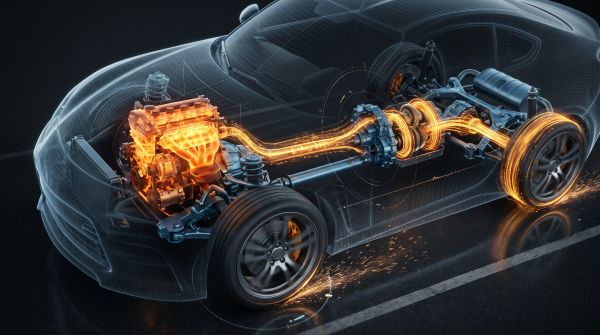
For everyday street driving, the factory hardware of a vehicle is already more than capable. What truly determines whether a car or motorcycle feels "good to drive" has never been the peak horsepower right before redline, but rather the completeness and zero-loss efficiency of power delivery every single time you press the throttle.
When many drivers get into tuning or start diagnosing their vehicle’s performance, any sluggishness off the line or hesitation when overtaking immediately triggers the same thought: "Do I lack torque? Should I upgrade the exhaust, swap the intake, or even install a bigger turbo?"
Yet, if you ask seasoned enthusiasts who have paid hefty "tuition" on their tuning journeys—whether they drive turbocharged CVT SUVs or ride scooters and heavy motorcycles—most eventually come full circle to the exact same conclusion: for street use, blindly piling on aftermarket hardware is rarely as effective as squeezing 100% of the drivetrain efficiency out of the stock setup.
I. Why Does a Car Feel "Sluggish and Delayed" on the Street Despite Adequate Paper Horsepower?
Modern automotive engineers have already calculated the optimal mechanical balance for everyday roads when designing engines and transmissions. When a stock vehicle feels lethargic and requires a heavy foot on the gas to get moving, the problem usually isn't a lack of engine horsepower. Instead, power is being lost layer by layer on its journey from the combustion chamber to the tires within the most frequently used street RPM range of 1,500–2,500 RPM:
-
Micro-leakage at the source (Blow-by): In small-displacement turbo engines or single/twin-cylinder motorcycles, the oil pump is still spinning slowly around 2,000 RPM, yet combustion chamber pressures spike dramatically the instant you step on the throttle. If you use a conventional, conservative motor oil, the oil film gets squeezed too thin under this low-RPM, high-pressure load, failing to completely seal the microscopic gaps between the piston rings and cylinder walls. A portion of that newly ignited combustion pressure leaks right past. Once pressure leaks at the source, the low-end torque you need most on the street naturally falls flat.
-
"Protective slippage" in the drivetrain: Whether it is an electronically controlled automotive CVT or a purely mechanical scooter variator and clutch, both share a common physical nature: when they detect insufficient input torque, they allow RPMs to flare up before gradually engaging. When the engine fails to deliver full torque due to low-end blow-by, the transmission exhibits that classic "rubber-band lag"—RPMs shoot up first, and vehicle speed catches up half a beat later. More than half of your throttle input in city traffic is wasted on revving and slippage rather than converting into actual wheel thrust.
II. Why Blind Hardware Mods Often Make Street Commuting Worse
Faced with weak low-end power, many instinctively turn to hardware upgrades—installing 300-cell high-flow catalytic converters, straight-through exhausts, or oversized intakes on cars, or spending tens of thousands on aftermarket variators and stiffer clutch springs for scooters.
While these mods do help the engine breathe better at high RPMs and rev faster, they often backfire in stop-and-go city traffic filled with red lights:
-
Aftermarket intakes and exhausts bleed away vital street torque: Making the exhaust or catalytic converter too free-flowing on a small turbo engine improves top-end pull above 4,000 RPM on the highway, but directly sacrifices the crucial exhaust backpressure and intake velocity needed at 2,000–2,500 RPM in the city. The result is an even emptier low end during daily overtakes and hill climbs, pronounced turbo lag, and a transmission forced to rev even higher just to move the car. Not only does it drive worse and create annoying cabin drone, it also turns annual vehicle inspections into a headache.
-
Aftermarket scooter transmissions force thrust through high RPMs and high fuel consumption: Performance variators and stiff springs force the engine to stay constantly in a high-RPM band. While this masks sluggish launches, the trade-off is noisy city cruising, a heavy throttle hand (constantly wringing the grip), worse fuel economy, and accelerated heat soak and wear on the drive belt and surrounding components.
III. The True "Zero-Loss Street" Mindset: Extracting 100% Efficiency from Stock Hardware
For street driving, instead of spending a fortune disrupting factory calibration to chase virtually unusable "peak horsepower," flip the script: how can you achieve zero blow-by and zero slippage from your stock hardware right in that 2,000–2,500 RPM sweet spot?
-
Seal the combustion chamber with a top-tier oil film: Motor oil is more than just a lubricant; it is the most critical "liquid gasket" between the piston rings and cylinder walls. When you switch to a high-polarity, ultra-high shear-strength ester/polyol-ester (POE) motor oil (paired with an appropriate extreme-pressure anti-wear package), it clings to metal surfaces like a magnet, holding firm against cylinder pressure during low-RPM, high-load combustion without letting a single drop of pressure escape.
-
Once source compression is locked in, drivetrain efficiency awakens automatically: When the engine delivers full, uncompromised torque at low RPMs, a remarkable chain reaction occurs:
-
Electronic CVT vehicles: The Engine Control Unit (ECU) sends a robust, genuine torque signal to the Transmission Control Unit (TCU). To prevent belt slip, the TCU proactively raises clamping oil pressure and locks up the torque converter earlier. A car that previously had to flare its RPMs when accelerating at 60 km/h in the city can now bite down with high hydraulic pressure and surge forward below 2,000 RPM.
-
Mechanical CVT scooters: Without touching aftermarket transmission parts, the stock variator and clutch are pushed forward effortlessly by full low-end torque—staying quiet, fuel-efficient, and responsive to the slightest twist of the wrist.
-
-
Precise driving rhythm: When you need to accelerate or change lanes in traffic, using simulated gears (such as mid-to-high gear ratios) helps the transmission build high clamping preload beforehand. Once up to speed, shifting back into Drive (D) lets you cruise smoothly, keeping power delivery linear, predictable, and instant every single time.
IV. When Do You Actually Need Major Hardware Upgrades?
Of course, this does not mean hardware modifications are worthless. If you are chasing lap times on a track, drag racing, or full-throttle top-end pull above 180 km/h, then a larger turbo, high-flow exhaust, and upgraded cooling systems are indeed essential.
However, as long as your stage is everyday streets, city commutes, and weekend mountain roads, what your right foot actually feels and enjoys every day is never that distant peak number in the top-right corner of a dyno chart. It is the direct, full-bodied sensation of the combustion chamber translating every ounce of energy into tire thrust the moment you feather the throttle.
Keep the durable factory hardware intact, preserve your exhaust backpressure and inspection legality, and invest your budget in a top-tier oil film that locks in compression alongside disciplined maintenance. When a vehicle extracts 100% of its stock drivetrain efficiency on the street, you will realize that a car or bike that is "great to drive, smooth, and responsive on demand" doesn't require major surgery at all.