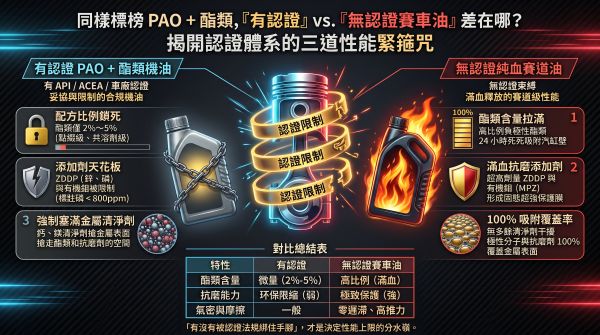
Many car owners who know a thing or two about motor oil ingredients deliberately avoid conventional mineral oils, specifically targeting high-end engine oils labeled "PAO + Ester" on the bottle—yet they often run into a common question: "Since both use PAO + Ester base oils, what is the actual difference between buying a high-end oil with 'automaker or international certifications' versus buying a 'non-certified purebred racing oil'?"
The answer is straightforward: As long as a bottle of oil carries an official certification (API / ILSAC / ACEA / European OEM approvals), no matter how good its base oil foundation is, its true physical performance remains locked down by "three performance shackles" imposed by certification regulations.
It is like equipping a race car with a top-tier chassis, only to forcefully install an air restrictor plate on the intake—its horsepower ceiling is permanently sealed near the bare passing line:
1. "Locked Formulation Ratios (The Certification Cage)": Contains Ester, But Only at a "Garnish Level" The mechanism behind automaker and industry association certifications isn't simply "sending in a bottle of oil to pass a test." Instead, the entire ratio of base oils and additives must be locked in to pass engine bench tests costing hundreds of thousands of dollars. Once certified, the formulation ratio is strictly frozen—not even a single gram can be added.
-
Daring Not to Max Out Ester Concentration: If high-polarity esters are added in too high a concentration, they risk crossing the boundary lines set by certain certification standards regarding "specific rubber seal swell rates" or "long-life oxidation tests."
-
Consequently, the vast majority of "certified PAO + Ester engine oils" actually contain only 2% to 5% ester (just enough to print the word Ester on the bottle, or a "co-solvent grade" amount used merely to dissolve additives).
-
In contrast, purebred non-certified track oils do not need to cater to these commercial certification boundaries. They can push high-polarity ester ratios to levels capable of generating "0.0-second full-strength magnetic retention"—even after the car is shut off and parked overnight, the oil film remains tightly clung to the cylinder walls without draining away.
2. "Additive Ceilings (Chemical Limits)": Even the Best PAO + Ester Cannot Save Slashed Zinc, Phosphorus, and Organic Molybdenum No matter how strong the base oil (PAO + Ester) is, during extreme high-pressure boundary lubrication (such as the instant of full-throttle launch, or the exact millisecond a piston reverses direction at top and bottom dead center), a liquid oil film will inevitably be squeezed to its limit. At this moment, what truly determines the ceiling of cylinder compression sealing and anti-wear protection is the solid protective film formed by high-dose extreme-pressure zinc (ZDDP) and track-grade organic molybdenum (MPZ).
-
Mandatory Regulatory Restrictions: As soon as an oil carries official environmental certifications (such as API SP / SQ, ACEA C3 / C5, etc.), regulations force phosphorus levels below 800 ppm and sulfated ash below 0.8%.
-
This means that even if a certified oil uses top-tier PAO + Ester, its most potent "solid compression-sealing zinc base layer" and "full-strength organic molybdenum friction modifiers" are slashed by more than half by regulations. Its compression-locking capability and friction-reduction ceiling under high loads are inherently no match for non-certified racing oils.
3. "Force-Filled with Metallic Detergents": Fighting Polar Esters and Anti-Wear Agents for Territory on Cylinder Walls To pass long-drain interval (10,000–15,000 km) sludge tests, Total Base Number (TBN) retention tests, and Low-Speed Pre-Ignition (LSPI) tests, certified engine oils must be forcefully loaded with high proportions of calcium and magnesium metallic detergents.
-
In tribology, there exists a fundamental conflict: "A detergent's job is to wash substances off metal surfaces" vs. "Polar esters and anti-wear agents' job is to cling tightly to metal surfaces to form a protective film."
-
In certified PAO + Ester oils, because detergent ratios are artificially inflated by regulations, the "actual adsorption coverage" of polar esters and anti-wear molecules on the cylinder walls is diluted and crowded out by detergents. Conversely, non-certified track oils dedicate 100% of the metal surface adsorption sites to negatively charged polar esters, high zinc, and organic molybdenum—putting their film density and compression-locking efficiency in a completely different league.
Understanding the Core Differences at a Glance(Note: You can insert the comparison table or infographic here)
When choosing engine oil, "PAO + Ester" is merely the entry ticket for a solid physical foundation; "whether its hands are tied by certification regulations" is the true watershed that determines its performance ceiling.
Certified PAO + Ester engine oils are certainly superior to ordinary mineral oils, yet they remain "compliant oils" compromised for environmental regulations and long-interval cleanliness. Only a purebred, non-certified formulation—one that strips away all three certification shackles—allows high-polarity esters and full-strength friction/anti-wear additives to perform without reservation, completely unleashing your engine's previously sealed potential for zero-lag response, full-compression thrust, and low-heat fuel efficiency.