The Guidance Within the Green Light: Understanding the "Running Man" in the Dark
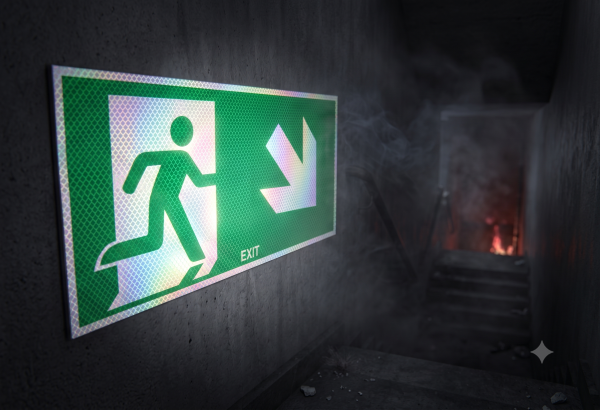
In our daily lives, we often catch sight of a green rectangular sign quietly mounted on a wall corner, above a doorway, or next to an emergency staircase. It features a white silhouette of a man in mid-stride, dashing toward an open door, usually accompanied by a bold arrow. Known internationally as "Mr. Pictogram" (from ISO 7010), this seemingly ordinary image is actually the most critical guardian in modern architecture—the emergency exit sign.
When the peace of daily life is shattered by the piercing wail of a fire alarm, leaving a building plunged into darkness and filled with rising smoke, this unassuming sign becomes the sole lighthouse at the boundary between life and death.
1. Why Green? The Science and Psychology of Color
Many people wonder why exit signs use "green" instead of "red," which typically signifies danger or fire. This choice is backed by strict scientific and psychological considerations:
-
A Psychological Sense of Security: In fire psychology, red is instinctively associated with "flames, danger, and prohibition." Flooding a smoke-filled, panicked environment with red lights could severely heighten the anxiety of evacuees. Conversely, green represents "safety, rescue, and passage," providing a calming psychological cue to the brain.
-
Visibility in Dense Smoke: Due to a biological phenomenon known as the Purkinje effect, the human eye is significantly more sensitive to green wavelengths than red ones in low-light conditions. Furthermore, green light penetrates certain types of smoke more effectively, making it easier to spot from a distance.
2. Decoding the Arrow: More Than Just a Direction
Many assume that the arrow on an exit sign is merely decorative. In reality, its orientation carries highly specific meaning.
Taking a "diagonal downward" arrow as an example, international standards (ISO 7010) and national fire codes generally use it to convey two core messages:
-
Changing Floors: It indicates that you need to move downstairs from this point (e.g., entering an emergency stairwell to descend).
-
Direct Pointing: The arrow points directly toward the physical exit door at the floor level, signaling, "The door is right here—push it open."
Additionally, the grid-like pattern on the surface consists of high-efficiency reflective or photoluminescent materials. Even if a building completely loses power, the slightest beam from a flashlight will cause the sign to reflect light instantly, revealing a sharp, clear outline in the dark.⚠️ A Critical Rule of Thumb for Evacuation: If you follow the green sign and open the door to an emergency stairwell, only to find it flooded with thick smoke and searing heat, you must NOT force your way through. In a fire, the ultimate killer is almost always toxic smoke, not the flames themselves.The correct course of action is to immediately close the fire-rated door to block the smoke, retreat to a relatively safe room, seal the door cracks with clothing, and call emergency services to report your location. The "Running Man" leads to safety only when the path is clear of smoke and visibility is intact.
The next time you stroll through a shopping mall, an office building, or a movie theater, take a moment to look up and spot the "Running Man." Standing guard silently in the corners of our infrastructure, he uses that gentle green glow to whisper the code to safety.
Remember his guidance and understand his language—in a critical moment, he is the most reliable guide for you and your loved ones.