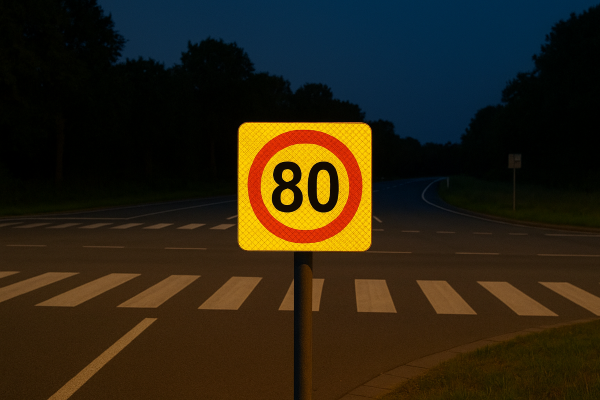
The Silent Sentinel: A Reflection in the Night
In the bustle of the day, the speed limit sign stands lonely and humble. Stationed by the roadside, coated in highway dust and exhaust fumes, it resembles a rigid moralist forgotten by time. Amidst the rush of traffic flowing at over a hundred kilometers per hour, drivers skim past it, ignore it, or even reject it with a hint of annoyance at its restrictions. It is like an ordinary tree in the background—static, silent, and devoid of life.
Yet, when twilight swallows the earth, this metal plate finally awakens to its true purpose.
The highway at night is a vast labyrinth of emptiness. As the darkness erases the surrounding landscapes, trees, and distant mountains, the world shrinks into a narrow tunnel illuminated only by headlights. In this ultimate isolation, drivers easily slip into a hypnotic state of "speed numbness"—the low hum of the engine becomes a lullaby, the dashboard needles blur into meaningless numbers, and the foot on the gas pedal presses deeper, unnoticed. Speed breeds the illusion of absolute control, until that "silent sentinel" suddenly ignites in the dark.
The most fascinating philosophy of the reflective sign lies in its passivity and resonance. It possesses no internal energy source, consumes not a single watt of electricity, and contains no light-emitting diodes. The reason it can erupt with a piercing white light in the pitch black is entirely because you have arrived.
This is a dialogue of light and shadow. However much provocative high-beam light you throw at it, it hurls back an equal measure of awakening admonition. It uses your own energy to warn you; it harnesses the momentum of your advance to curb your frenzy. When that bright white "number" crashes into your field of vision without warning, it is not an accusation from the outside world. It is the reflection of your own light in a mirror—a silhouette named "Reason."
What it illuminates in that split second is, in fact, the driver’s fading conscience. With a glow that is nearly gentle yet utterly undeniable, it questions every traveler: In the darkness where the road ahead is unseen, what exactly gives you the confidence to drive so fast? Can the steering wheel in your hands truly bear the weight of this reckless speed?
When your heart skips a beat, and your right foot instinctively eases off the accelerator or taps the brake—as the car's nose dips slightly and the speed obediently drops back into the realm of safety—this brief conversation comes to an end.
The moment you pass the geometric angle where your headlights intersect with the aluminum plate, the sign instantly extinguishes in your rearview mirror, retreating once more into the boundless night and silence. It claims no credit, nor does it follow. It merely continues to stand lonely in the wind, waiting for the next beam of light to pierce the night sky, ready to awaken the next spiritual resonance of "slowing down."
From a purely physical standpoint, it is nothing more than a reflector; but through the lens of humanity, it is the gentlest alarm the highway gifts to the midnight traveler.
The Structural Anatomy of the Sign
-
Retroreflective Sheeting By day, it is a rather dull sheet of aluminum, cloaked in a thin film embedded with thousands of microscopic glass beads or microprisms, remaining utterly obscure. Yet, its design essence is to "return light directly back to its source." This means it does not rob the night sky of its splendor, nor does it waste energy by scattering it aimlessly in all directions. Instead, it focuses entirely on taking the headlights projected by the driver and feeding them precisely back to the driver themselves.
-
The Graphic Command Enclosed within the geometric framework of a circle or rectangle, the stark, bold number 50 is encased in a striking border. This number is a microcosm of the social contract; it possesses no physical power to block your path, yet it carries the full weight of law, safety, and order.
-
The Threshold (Geographical and Psychological Boundaries) It typically stands at the critical junction of spatial transition: where a desolate interstate highway yields to a bustling fringe town, or where a straight, smooth road cuts into an unpredictable series of sharp curves. It announces a change in rules and heralds what lies ahead—be it a school, an elderly pedestrian, or a stray cat darting across the asphalt. It is the boundary line where the rhythms of life intersect.