The Structural Transformation of Taiwan’s Service Industry: Beyond the 2025 Closure Wave
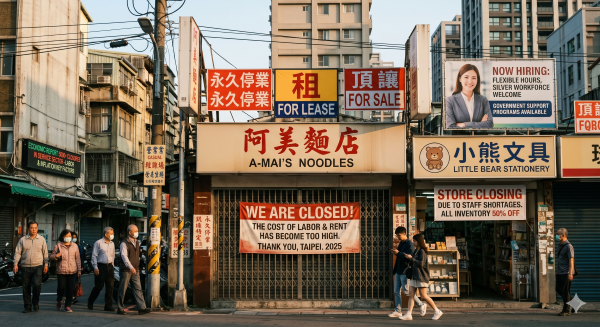
In 2025, over 5,000 storefronts across Taiwan's F&B, wholesale, and retail sectors closed down. While this may appear to be a standard part of the business cycle, it is actually a concentrated explosion of structural pressures. The dual squeeze of labor shortages and inflation has left SMEs (Small and Medium Enterprises) with rapidly shrinking profit margins due to hiring difficulties, rising wages, and escalating costs for raw materials and rent. These closures signify more than just individual management failures; they mark the end of an era for a service industry reliant on low-cost operations.
The New Reality of Labor and Inflation
The labor shortage has evolved from a short-term hurdle into a permanent structural fixture. Factors such as a declining birthrate and an aging population have shrunk the labor supply. Furthermore, the service industry—characterized by long hours and limited wage growth—has lost its appeal to the younger generation. Even when operators increase pay and bonuses, the gap remains. This labor vacuum does not just hurt efficiency; it degrades service quality, creating a vicious cycle of customer loss and dwindling revenue.
Simultaneously, inflationary pressures have upended traditional business models. As overhead costs rise, operators face a dilemma: raise prices and risk losing price-sensitive customers, or absorb costs and watch profits erode. This has accelerated a market "shake-out," where weaker players are rapidly eliminated.
Adaptation and Its Limitations
To survive, enterprises are exploring alternatives such as hiring international students, diversifying their workforce, or investing in automation. However, these are often localized or short-term fixes. Foreign labor involves complex regulations, and automation requires significant capital investment that many SMEs cannot afford. This suggests that individual corporate efforts alone cannot resolve these deep-seated structural issues and may even widen the resource gap between large and small firms.
A Strategic Framework for Government Response
Addressing this crisis requires a systemic policy response:
-
Labor Reform: Re-examine foreign labor policies to allow the reasonable introduction of workers into the service sector, supported by robust management and protection mechanisms.
-
Technological Incentives: Provide tax breaks or subsidies to encourage SMEs to adopt digital and automated equipment, reducing labor dependency and boosting productivity.
-
Skill Upgrading: Strengthen vocational training to transform service roles into high-value professional careers. Promoting flexible work hours and senior employment (silver-haired workforce) can also stabilize the labor supply.
-
Industrial Scaling: Encourage chain-store models to achieve economies of scale while helping smaller shops pivot toward specialized, branded niche markets to avoid price wars.
-
Financial Buffers: Establish flexible rent negotiation mechanisms and provide short-term liquidity support or "Digital Transformation Loans" to prevent closures caused by temporary cash flow interruptions.
Conclusion: A Signal for Industrial Evolution
This wave of closures is a clear signal of industrial transformation. The market is purging low-efficiency, low-value-added models in favor of high-efficiency and differentiated competition. For the government, the goal is not merely to reduce the number of bankruptcies, but to facilitate an industry-wide upgrade.
The dual pressures of labor shortages and inflation are here to stay. Future survivors will be those who can restructure their operations, leverage technology, and redefine their value proposition—ultimately reshaping the landscape of Taiwan’s service industry.