Gary Shilling Warns: U.S. Recession "Inevitable," S&P 500 Could Plunge 30%
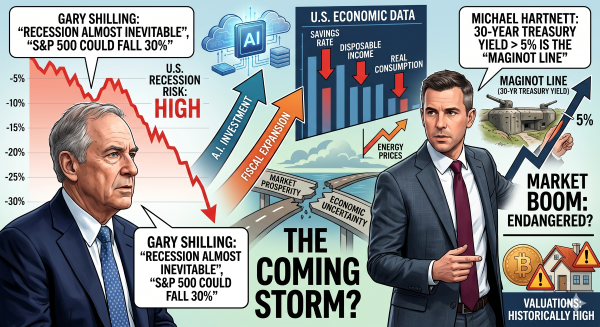
Renowned economist and former Merrill Lynch strategist Gary Shilling stated in a recent interview that a U.S. recession is "almost inevitable" this year. He warned of a major stock market correction, suggesting the S&P 500 could drop by as much as 30%, with a bear market potentially emerging as early as year-end.
According to Business Insider, Shilling pointed out that the U.S. economy is currently flashing vulnerability signals across multiple sectors, significantly increasing downside risks. He believes that unless there is massive fiscal stimulus or U.S. consumer power remains unexpectedly resilient—neither of which seems likely—preventing a recession will be difficult.
A Broad Weakening: From Housing and Capital Expenditure to Consumption
Analyzing the economic structure, Shilling highlighted several key red flags:
-
Stagnant Housing Market: With interest rates expected to remain high, the housing market has ground to a halt. While a brief dip in mortgage rates last year spurred a temporary recovery in existing home sales, activity has cooled significantly as rates climbed again.
-
Weakening Capital Expenditure: Despite the boom in Artificial Intelligence (AI) investments, overall capital expenditure momentum has slowed. Data shows that total capex growth was only 3.9% at the end of last year—a sharp decline from the pandemic peak of over 24%—indicating corporate caution.
-
Fading Consumer Demand: Consumption accounts for roughly two-thirds of the U.S. economy. While it has remained a pillar of support, signs of fatigue are appearing. Real personal consumption expenditure growth held at approximately 2% in March, but persistent inflation and rising costs suggest a downturn in the coming year.
Shilling further noted that U.S. households are under immense pressure from cumulative price increases since the pandemic and recent inflationary spikes driven by geopolitical tensions. Official data showed energy prices surged 12.5% year-over-year in March, the largest increase since 2022, reflecting the impact of rising oil prices.
Furthermore, income and savings data reveal weakening support for spending. In March, real disposable income growth dropped to 0.4%, a three-year low, while the personal savings rate fell to 3.6%, the lowest level since 2022. Shilling emphasized that with slowing income growth and dwindling savings, consumer sentiment is in a "very fragile state."
S&P 500 Nears Dot-com Bubble Peaks
Regarding capital markets, Shilling argues that stock valuations have reached alarming heights.
-
Valuation Metrics: The inflation-adjusted Shiller CAPE ratio for the S&P 500 is approaching levels seen just before the Dot-com bubble burst.
-
Historical Precedent: Other indicators, such as Price-to-Earnings (P/E) and Price-to-Book (P/B) ratios, are hitting historical highs.
Shilling stated that stocks are currently "very expensive" and predicted a major correction is imminent. He noted that historical 20% to 30% pullbacks are not uncommon, making such a decline "very likely" by the end of 2026. While he admitted the specific catalyst for a crash remains unclear, he suggested that AI—while significant—has not yet signaled a definitive bubble.
The "Maginot Line": 30-Year Treasury Yields at 5%
Shilling has maintained a bearish outlook for years, frequently warning of "extreme speculative behavior" in AI and cryptocurrencies.
Echoing some of these concerns, Michael Hartnett, Chief Strategist at Bank of America, noted in a recent report that the current stock market rally is fueled by massive government fiscal expansion and explosive AI investment, creating a "virtuous cycle."
However, Hartnett warned of a critical vulnerability: if the 30-year U.S. Treasury yield breaks above the 5% "Maginot Line," the current market prosperity could come to an abrupt and rapid end.