

Is certification a guarantee of longevity, or a shackle on performance?
The Mystery of the "Missing Torque": Why High-Mileage Engines Feel Weak on OEM-Certified Oils
Many car owners, once their odometer hits the 200,000 km mark, opt for premium oils adorned with a "Grand Slam" of certifications from BMW, MB, VW, and Porsche to give their engine the best possible protection. These oils are expensive, feature cutting-edge tech like "Titanium Fluid," and promise "long-life protection."
Yet, paradoxically, the driving experience often underwhelms. Climbing hills feels hollow, torque delivery lacks substance, and the engine note becomes thin or shrill. Why is this happening?
1. The True "Mission" of Certified Oils: Environmental Compliance Above All
We must first understand that European OEM certifications (such as ACEA C3 or VW 504/507) are not designed to make your engine "more powerful." Their primary benchmarks are:
-
Protecting Exhaust Systems: To prevent DPF (Diesel) or GPF (Gasoline) filters from clogging, they strictly limit levels of phosphorus, zinc, and sulfated ash.
-
Extreme Fuel Efficiency: To pass stringent EU carbon emission tests, these oils are engineered with extremely thin films to minimize internal drag.
-
Long Drain Intervals: Ensuring the oil remains chemically stable for up to 20,000 km without forming sludge.
When the priority is placed on component lifespan and emissions testing, "throttle feedback" naturally drops to the bottom of the list.
2. The Reality of 200,000 KM: Fading Airtightness
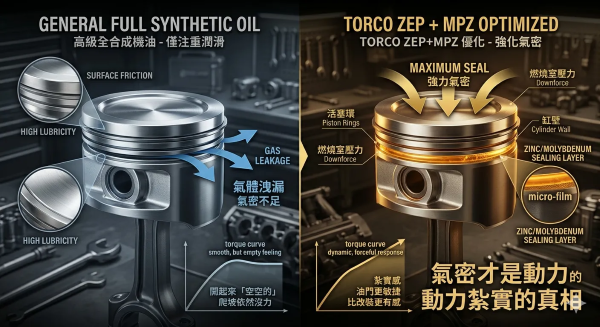
Even in a well-maintained high-mileage engine, physical gaps inevitably develop between the piston rings and cylinder walls. At this stage, what the engine needs most is physical airtightness.
-
The Impotence of Certified Oils: These products rely on advanced chemical molecules (like Titanium) to reduce friction under pressure. However, in the wider clearances of a high-mileage engine, these paper-thin oil films cannot act as a "sealant" for the combustion chamber. When combustion occurs, pressure leaks through these gaps—and your torque leaks out with it.
-
The Solidity of Physical Coatings: In contrast, technologies like Torco MPZ—which emphasize the physical stacking of molybdenum, phosphorus, and zinc—work by "painting" a resilient buffer layer onto metal surfaces. This layer fills wear gaps and seals in the cylinder pressure. When cylinder pressure is maintained, every drop of fuel is fully converted into torque at the wheels.
3. The Sensory Difference: Free-Spinning vs. Propulsive Thrust
On a high-mileage car using "purely certified oil," there is often a hollow sensation where the RPMs climb faster than the car actually accelerates. Because of poor airtightness, the engine must rev higher to compensate for lost torque, leading to a noisy but weak experience.
When you switch to a technology focused on "Sealing and Anti-wear" (such as MPZ), the changes are immediate:
-
Low-End Torque Surge: The car pulls with a light touch of the pedal, reducing the need for frequent downshifts.
-
Acoustic Shift: The shrill friction noise transforms into a deep, solid hum, signaling increased buffering between metal components.
Conclusion: Is Certified Oil Enough?
The answer: Protection is guaranteed, but "driving pleasure" is not.
For a brand-new car, certified oils are a perfect safety net. But for an owner with over 200,000 km who seeks a "man and machine as one" feedback, you don't need an environmental certificate—you need physical reinforcement that can restore cylinder pressure and bridge the gaps of time.
Next time you change your oil, stop obsessing over the list of certifications on the back of the bottle. Listen to the engine’s sound and feel the response on a climb. That is the engine’s most honest confession.
.png)

