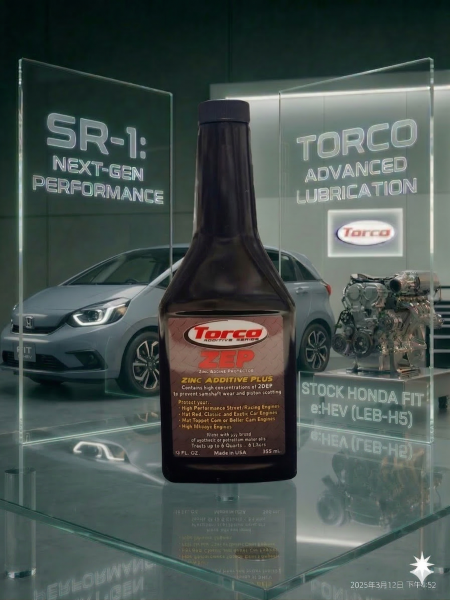
Hybrid Owners Must Read: Is 0W-20 Low-Viscosity Oil a Fuel Saver or an Engine Killer? The Truth About Torco ZEP Protection
As global fuel economy regulations (CAFE) become increasingly stringent, modern Hybrid Electric Vehicle (HEV) manufacturers have shifted entirely toward ultra-low viscosity oils, such as 0W-8, 0W-16, or 0W-20. While these oils deliver impressive fuel consumption figures, many owners wonder: "Is an oil this thin actually protecting my engine?"
This article reveals the hidden dangers of low-viscosity oil that manufacturers don't mention and explains why Torco ZEP (Zero Friction Engine Protector) is the essential chemical savior for hybrid engines.
I. Why Do Manufacturers Recommend Low-Viscosity Oil? The Unspoken Trade-off
Many owners ask: "If there’s a risk of wear, why does the manual insist on 0W-20?"
1. Built for Compliance, Not Longevity
Automakers are under immense pressure to meet government fleet averages for fuel economy and carbon emissions. Low-viscosity oil minimizes internal drag and reduces pumping losses, resulting in better laboratory test data. However, a manufacturer’s primary goal is to ensure the vehicle survives the warranty period, not to guarantee peak engine health at 200,000 miles.
2. The Crisis of Physical Oil Film Collapse (HTHS)
Low-viscosity oils typically have a lower HTHS (High Temperature High Shear) viscosity rating. Under high-speed cruising or heavy loads (like climbing steep grades), the extremely thin oil film is prone to rupturing. This leads to direct metal-to-metal contact between piston rings and cylinder walls—a technical failure known as "Boundary Friction."
II. The Hybrid Achilles' Heel: "Dry Friction" from Frequent Start-Stops
The core of hybrid operation involves the engine frequently cycling on and off. This places two severe demands on the motor oil:
-
Instantaneous Pressure: When transitioning from EV mode to internal combustion, engine RPMs spike instantly. At this moment, oil pressure has not yet fully stabilized, and oil has not reached all friction surfaces.
-
Rapid Drainage: Low-viscosity oil flows quickly; once the engine shuts down, it drains rapidly back into the oil pan. This means that every time the engine restarts, the residual oil film is at its thinnest.
Over time, this repeated "Cold Start/Dry Friction" cycle leads to increased vibration, louder engine noise, and a significantly shortened engine lifespan.
III. Torco ZEP: MPZ Technology Engineered to Bridge the Gap
When physical oil films fall short, the solution isn't to switch to a "thicker" oil (which ruins fuel economy), but to strengthen the chemical protection. Torco ZEP, powered by patented MPZ (Molybdenum Phosphor Zinc) technology, was designed specifically for this purpose.
1. Magnet-like Chemical Film: Protection at Startup
ZEP’s MPZ molecules possess high surface activity, adhering to metal parts like magnets. Even when the engine is off and the oil has drained away, this chemical shield remains bonded to the metal. At the instant of a restart, it provides immediate buffering, effectively eliminating dry friction.
2. Fully Liquid Formula: Zero Blockage
Many owners fear that additives might harm their engines. Torco ZEP features a fully liquid chemical formula—containing no graphite, PTFE (Teflon), or ceramic particles. It is perfectly compatible with all major brands of synthetic oil and will never clog precision oil galleries or filters.
For savvy hybrid owners, chasing extreme fuel economy shouldn't mean sacrificing engine health. By adding 3% to 5% Torco ZEP, you can enjoy the fuel-saving advantages of low-viscosity oil while gaining anti-wear protection that exceeds that of much thicker oils.
Don't let "just enough" OEM standards limit your engine's protection. Equip your hybrid engine with an invisible layer of chemical armor today.
IV. Protection Comparison: OEM 0W-20 vs. 0W-20 + Torco ZEP
| Performance Metric | OEM 0W-20 Alone | 0W-20 + Torco ZEP |
| Oil Film Strength | Weak; prone to high-temp rupture | Extremely high chemical resilience |
| Startup Protection | Risk of instantaneous wear | Full-time magnetic protection |
| Operating Quality | Vibration increases with mileage | Smooth, quiet, and refined |
| Long-term Benefit | Meets basic warranty standards | Extends peak engine lifespan |