1. The Potential Impact of Fire Incidents on Construction Safety Netting
The recent fire at a construction site in Gushan District, Kaohsiung, occurred on the 26th floor of a high-rise building. Although no casualties have been reported so far, the rapid spread of the fire and the difficulty of firefighting operations highlight the critical role that exterior construction materials and protective systems play during fire incidents.
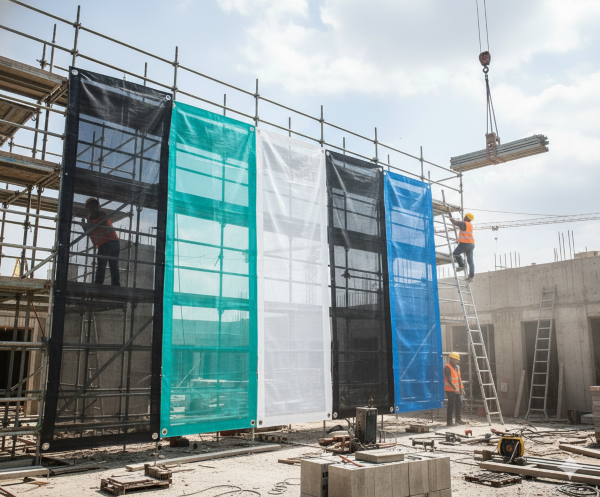
Construction sites commonly use scaffold netting and debris netting to prevent dust dispersion and falling objects. However, if these materials do not possess flame-retardant properties, they can significantly accelerate fire spread when exposed to flames, increasing overall risk and hazard.
🔥 2. Differences Between Standard Debris Netting and Flame-Retardant Debris Netting
📌 Standard Debris Netting (Conventional Scaffold Netting)
-
Most standard debris netting is made from polyethylene (PE) or polypropylene (PP), which are highly flammable and can promote combustion.
-
When ignited, these materials burn rapidly and can create a “chimney effect,” allowing flames to travel quickly upward along the building façade.
-
During combustion, they release dense smoke, toxic gases, and may produce burning molten droplets that can ignite other combustible materials.
📌 Flame-Retardant Debris Netting (Fire-Resistant Scaffold Netting)
-
Flame-retardant netting is treated with special processes or manufactured using fire-resistant materials, enabling it to self-extinguish once the ignition source is removed.
-
When exposed to fire, the material tends to char and shrink rather than propagate flames, significantly reducing the likelihood of vertical fire spread along the netting.
-
While flame-retardant netting is not equivalent to a fire wall, it plays a crucial role in mitigating fire spread and represents an advanced level of safety protection for construction sites.
🔎 3. Why Flame-Retardant Debris Netting Is Essential
➤ Preventing Rapid Fire Escalation (Chimney Effect)
Flame-retardant debris netting helps block the upward path of flames along façades and scaffold structures during the early stages of a fire, slowing down fire propagation.
➤ Reducing Molten Drips and Toxic Smoke
Flame-retardant materials burn more slowly and for a shorter duration, reducing secondary hazards caused by high-temperature molten droplets and toxic fumes.
➤ Improving Evacuation and Firefighting Conditions
By slowing the spread of fire and smoke, flame-retardant debris netting enhances evacuation safety and improves conditions for firefighting and rescue operations.
Do Not Compromise Safety for the Sake of Cost Savings
In recent years, multiple construction fire incidents have repeatedly reminded us that safety is never a cost to be reduced, but a fundamental requirement that must be prioritized. During project planning and construction, choosing low-grade or non-flame-retardant protective materials solely to reduce expenses can significantly amplify risks and may lead to irreversible consequences when accidents occur.
In high-rise construction projects, exterior scaffolding and debris netting are essential safety measures. Their purpose goes beyond dust control and falling object prevention; they also play a critical role in influencing fire spread and emergency response conditions. When non-flame-retardant netting is used, the material itself may become a source of combustion during a fire, creating a “chimney effect” that allows flames to spread rapidly upward along the building façade, greatly increasing the difficulty of firefighting operations and evacuation efforts.
By comparison, flame-retardant safety netting may involve a slightly higher initial cost, but its value during a fire far outweighs the price difference. Flame-retardant materials are designed to self-extinguish once the ignition source is removed and resist flame propagation, effectively slowing the spread of fire and buying critical time for emergency response and rescue.
Construction safety should never be treated as an area where savings are acceptable. A truly mature approach to project management is not about achieving the lowest possible cost, but about making the right decisions before risks materialize. The money saved upfront can never compare to the cost of a single serious accident.
Choosing certified, flame-retardant protective materials is not only a matter of regulatory compliance—it is a clear statement of responsibility toward human life, the surrounding community, and society as a whole.